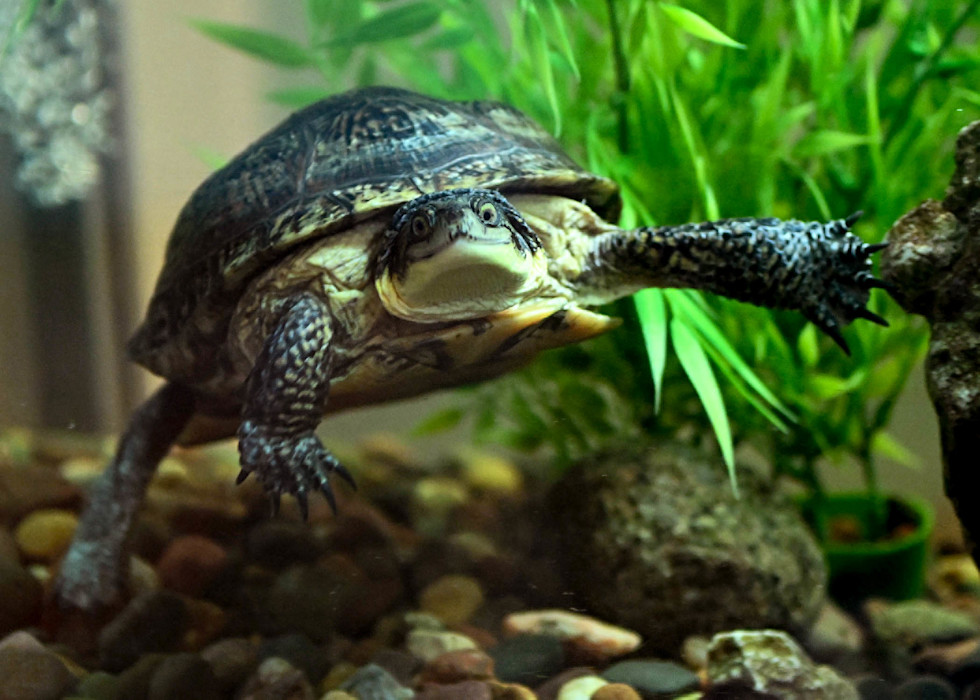
Summer is peak turtle fieldwork season for Brookfield Zoo Chicago’s Director of Conservation Medicine and Science Dr. Matt Allender and his students from the University of Illinois’ Wildlife Epidemiology Lab (WEL), where he also serves as Director. By partnering with organizations around the state, we learn about and monitor local wildlife health. For the 13th year in a row, Illinois turtle conservationists joined together for their big event of the year: the “Blanding’s Bowl.”
Standing in marsh water in the pouring rain, Illinois wildlife veterinarian Dr. Matt Allender pulled a long tapeworm out of a turtle.
His face lit up at the arguably skin-crawling sight.
“We’ve never found a tapeworm in a Blanding’s turtle!” he said.
The other researchers said they’ve never seen Allender so excited. There was gunk all over everyone’s waders, and the sky threatened lightning at any moment. But for this team of turtle enthusiasts, there was no place they’d rather be.
The stuff of nightmares was suffused with contagious delight. It’s hard to resist the excitement of Blanding’s Bowl — an annual blitz to assess turtle health in the wetlands of Lake County, Illinois. Teams of biologists, wildlife veterinarians, the Zoo’s veterinary residents, and conservation researchers from the University of Illinois, Peggy Notebaert Nature Museum, and the Forest Preserves of Cook County and other districts, including Lake and DuPage counties, come together at the site of the largest remaining population of the endangered Blanding’s turtle (Emydoidea blandingii). They safely capture, assess, and release as many Blanding’s — and other turtle species — as possible in a week.
What makes it so energetic? It’s also a fierce competition. The rest of the year, these partners are scattered across the state monitoring all kinds of wildlife health. This is their chance to meet up and work together in one place on a shared passion. That doesn’t keep anyone from wanting to win, though.
Each team sets traps, and every turtle they catch and assess contributes to their points. Snapping turtles? Negative points, for obvious reasons (watch your fingers). Blanding’s? A winning find that warrants a glowing “shell-fie” dropped in the group chat (or shared on WEL’s social media). Forget to take a shell-fie, and you lose points. Teams race against the clock for victory, and for the sake of the endangered turtle whose numbers are dwindling. This year, they assessed 58 Blanding’s turtles in total.
The far-roaming, yellow-chinned turtle is threatened by ongoing habitat loss as wetlands suffer in Illinois. They often meet their fate crossing roads, and raccoons eat their eggs and hatchlings. Since they sometimes travel as far as a mile or more, they’re very vulnerable to habitat fragmentation. Now, there are less than 500 in the state. Thankfully, they’ve won the hearts of some persistent humans.
Looking for Turtle Disease
On this particular day, Blanding’s Bowl team “Stay Out of Our Marsh,” made up of Allender, WEL veterinary fellow London Wimberly, and Peggy Notebaert’s Curator of Turtle Conservation Dr. Callie Klatt Golba found only one Blanding’s turtle. That didn’t make the day any less interesting. This turtle, named "John Cougar Blandoncamp" (inspired by rock ‘n roll artist John Cougar Mellencamp) is an example of why these health assessments matter.
The team cheered when we found him in their final trap. With rain coating everyone’s phones, they worked together to input data about John Cougar Blandoncamp into a turtle database. He, too, was slick with rain and marsh water, so Allender held him as the other team members pulled out a scale, test tubes, swabs, syringes, and measuring devices. Blandoncamp waggled his arms, waiting for his check-up. His doctors recorded things like his weight, size, and shell markings.
They swabbed for samples last. Wimberly held his webbed foot, coaxing him to open his mouth for a spit sample. They gathered a variety of samples, and were nearly done when the tapeworm came, attached to a swab.
Everyone leaned in closely, waiting to learn more.
“I don’t know what this means!” Allender exclaimed.
Allender has been taking care of local turtles since 2015, so it may be surprising that he doesn’t have all the answers. But that very uncertainty is why he and his team do health assessments. The tapeworm, like other native parasites, might have been right where it was supposed to be. Just a regular hazard of turtle life. Or, it could have been out of place. Something not natural to this local environment, and therefore a potential threat to Blanding’s turtles or a sign that something is off in their ecosystem. That’s exactly what the teams are looking for: signs of what’s normal and what’s alarming for the species.
“Everything that we find is new,” said Golba. When we go to the doctor, they typically know what to look for and how to evaluate our symptoms. “We don’t know any of that stuff for turtles. We’re starting to learn all of that. Every day is a new discovery.”
By regularly gathering data on Blanding’s turtles, we can better understand and anticipate what threats the species is facing. That’s the groundwork Allender and Illinois Zoological and Wildlife Health Management residents at Brookfield Zoo Chicago help establish.
A recent example of this is the early discovery of the fungal pathogen Emydomyces testavorans in Blanding’s turtles for the first time. Research led by Allender and WEL researchers identified the pathogen in both Blanding’s turtles and red-eared sliders, and they were able to quickly put measures in place to curb its spread. By 2024, they sampled 1,200 turtles in Illinois and had zero positives for Emydomyces. Now, they’re working on developing a successful treatment for turtles that already have the disease.
Tracking Blanding's Turtle Health Over Time
Blanding’s Bowl participants may be speedy in their race to save a beloved turtle, but research takes time. The competition is annual not just because it’s a blast, but also because turtles need regular check-ups. Many turtles caught and assessed throughout the week are recaptures from previous years.
In the case of John Cougar Blandoncamp, he had last been seen seven years ago. He’s what’s called a head-start turtle, meaning he was raised in professional care and released into the wild at around four years old. This boost gave him a better chance at surviving to a reproductive age. Since Blanding’s turtles don’t typically reproduce until they are around 12 to 18 years old, that's a long journey. While this turtle is still young, finding him again years later is encouraging.
“99% of turtles die in the first year of life,” said Allender. “Head-starting helps to avoid those early mortalities.”
It will still be years before a new head-start Blanding’s turtle in Illinois reaches reproductive age. But every day in the field brings us one step closer to bolstering the population.
Now, we have more health records on the turtle, though it will take sample processing to know what that tapeworm had in store for him, and whether we need to worry about what it means for other turtles. The worm may be nothing, but either way, his doctors will try to find out so that they can better care for him and the rest of his species.
Allender put a cap on the test tube containing what was dubbed the “inaugural tapeworm,” and the group got ready to take the samples back to the lab. They just dodged the storm but were still soaked to the bone.
What ultimately made it worth it to stand knee-deep in muck under a downpour was an integration of urgency, passion, and camaraderie. Wild Blanding’s turtles in Illinois have no other doctors besides these people. They need this week of the best-of-the-best wildlife researchers coming to their aid with sheer joy in the face of a discouraging challenge. Their caretakers can’t turn back the clock on what the species has already lost. But they can bring their laughter, shell-fies, and commitment to each turtle they find in the field — even on the grossest of days.
“Sometimes Blanding’s turtles can be really stoic,” Allender said. “But in rainy weather, he’s out. He’s smiling. He’s telling us what’s going on.”
The turtle stretched its bright neck toward the sky, rain bouncing off his carapace. They released him, and he swam free, one tapeworm lighter.
Learn more about our other local conservation initiatives!