Brookfield Zoo Chicago isn’t just home to unique animals from around the world — we're also a registered arboretum, which means we’re home to an array of tree species.
As a level 2 registered arboretum through the ArbNet Arboretum Accreditation Program, we have over 100 species of trees on our grounds. Many of these trees provide animals with enrichment, habitat structures, and environments that encourage natural behaviors. They invite pollinators near and drop fruit and seeds for native wildlife. Across the park, they mark the land as part of the Forest Preserves of Cook County, bringing guests closer to wildlife they can recognize as their own. Though there are trees from around the world here, we focus primarily on planting and cultivating native species.
Want to recognize trees at the Zoo? Take a walk and spot some of our most striking tree species.
1. Persimmon, Diospyros virginiana
Did you know this sweet fruit tree is native to Illinois? Outside of Australia's indoor entrance, you’ll find persimmon trees with their distinctive blocky bark.
Persimmon trees grow male and female flowers on separate trees. This is referred to as a dioecious (dy-EE-shuhs) plant. Bees pollinate the trees, and small mammals disperse the seeds of the fruit.
2. American sycamore, Platanus occidentalis
An American sycamore towers above the giraffes outside Habitat Africa! The Kopje. You can’t miss this species, even in the winter — its yellow-gray bark peels up and down its soaring trunk, white bark peeking through underneath. Sycamores can grow up to 100 feet tall or more!
It draws a wide variety of birds and insect pollinators. In contrast with the persimmon tree, it’s monoecious (muh-NEE-shuhs), meaning it has separate male and female flowers, but they can be found on the same tree.
When settlers from the British Isles spotted this tree in America, they thought it looked similar to sycamores back home. They named it after the familiar tree — but the species in the British Isles was actually a maple!
3. Honey Locust, Gleditsia triacanthos
The small, glittering honey locust leaves are a familiar part of Chicagoland autumns, lining streets with gold. But this species carries characteristics from an unknown world. Over 10,000 years ago, honey-locusts cohabitated with mastodons and other large fauna. Their oversized seed pods attracted huge animals, so to protect their trunks, the trees grew long thorns.
Today, those thorns no longer serve a purpose and are often bred out of honey locusts for landscaping. In front of the nyala at Habitat Africa! The Savannah, though, you’ll find one with those signature spikes. They serve as reminder that an animal kingdom of massive creatures once wandered the same ground as us.
The animals at the Zoo might not be mastodons or giant sloths — but they get to eat the honey locust, too. The species is on our list of approved browse trees, meaning we can repurpose its fallen or trimmed branches for animal enrichment or food.
4. Weeping Willow, Salix babylonica
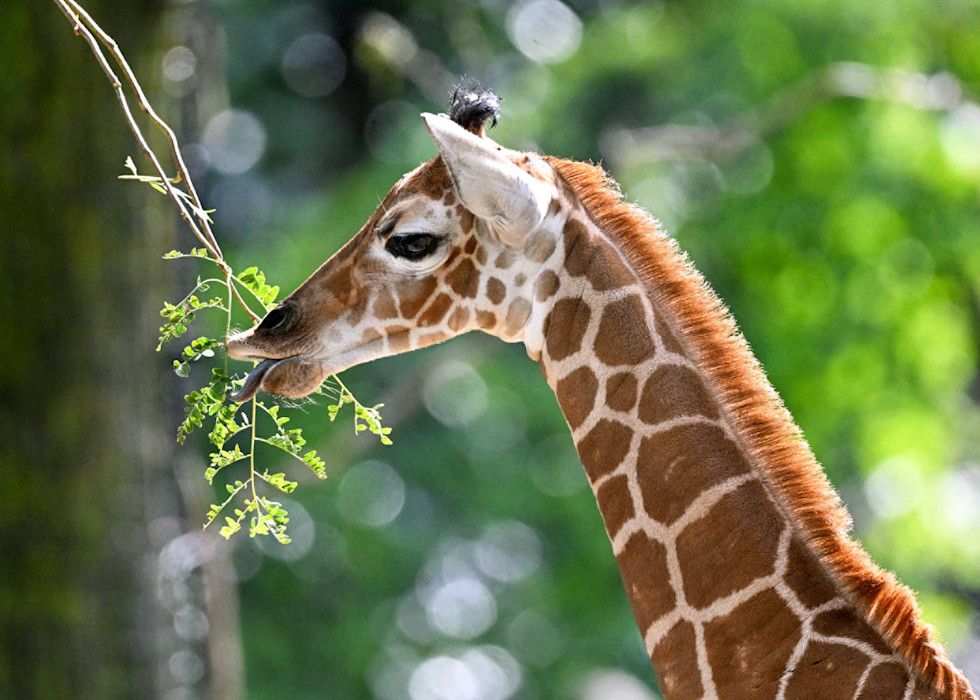
Though native to China, weeping willows are a great example of how animals at the Zoo benefit from trees around the park! If you pass by the bison habitat in Great Bear Wilderness, you’ll notice a perfectly trimmed willow at its center. It’s been pruned by the bison, who reach their heads as high as they can to chomp down its leaves. Trees like willows can stimulate natural foraging behaviors for animals, from bison to giraffes.
5. Green Ash, Fraxinus pennsylvanica
Unfortunately, you may recognize the green ash as a species on its way to extinction. The huge population in U.S. has been decimated by the emerald ash borer, an invasive insect native to Asia that nestles into the tree’s bark and blocks nutrients. An effective treatment hasn’t been discovered. It’s listed as Critically Endangered on the International Union for Conservation of Nature (IUCN) Red List.
There are only a few ash trees remaining on park grounds, but you can see one that’s still alive next to the Andean condor habitat across from The Living Coast. You can identify it by it branches directly opposite each other. Common canopy trees such as maples, ash, dogwoods, and horse chestnuts have opposite branch arrangement instead of alternating.
6. Bald-Cypress, Taxodium distichum
Though it’s atypical of conifers (cone-bearing trees), bald-cypresses are deciduous, meaning they drop their needles each winter. Hence the title “bald.” They are classic swamp trees with a distinct pyramid shape. In swamps, they grow aerial roots that look like knees to collect more oxygen.
Though you’ll have to venture inside to see these knee-like structures, you can spot a real bald-cypress in front of — you guessed it — The Swamp!
7. Hardy Rubber Tree, Eucommia ulmoides
The rubber tree is declining in its natural range in China, but it's highly adaptable and does well as a landscaping tree. Listed as Vulnerable on the IUCN Red List, this species has an estimated less than 1,000 mature trees left in the wild. It produces latex and is threatened by deforestation and over-exploitation.
Walking from East Mall to Hamill Family Wild Encounters, you can visit a hardy rubber tree growing along the fence.
8. White Oak, Quercus alba
Like the honey locust, the iconic white oak stands as a reminder of Illinois’ past. Before the land was developed for agriculture, the state was an oak savannah sprawling with trees and prairie grass supporting rich native life. Schoolchildren elected the native oak as the state tree in 1907. In 1973, the range was narrowed specifically to the white oak, establishing it as a symbol of our history.
With acorns, flowers, and a wide-reaching canopy, the white oak supports the life cycle of an estimated 500 to 2,000 species. Outside Malaya the snow leopard’s viewing window along Big Cats Walkway, a white oak invites guests and native wildlife alike to appreciate its place in our ecosystem.
Want to identify more trees around the park? Use our tree guide to look for species and learn more about them.