Discover how Brookfield Zoo Chicago's staff support the vital behavior of self-grooming and social grooming.
Grooming behaviors are vital to the health and well-being of many species. Most of the time, they do a great job of caring for their bodies on their own. But when they don’t, our animal care specialists have a few tricks up their sleeves.
On a walk through the Zoo, you may see a bird preening its feathers, a young animal being licked clean by its mother, or an ape picking debris out of another’s fur. These everyday animal behaviors may seem unremarkable, but the Zoo’s animal care specialists say there’s more going on in these scenes than meets the eyes.
These are examples of animal grooming behavior, or animals caring for the surface of their body — whether it is covered in skin, scales, feathers, fur, or hair. Although what is considered natural grooming behavior varies from species to species, it provides many benefits to animals from comfort and social bonding to disease prevention and predator avoidance. When grooming is inadequate, animals can suffer discomfort, pain, injury, or disease. In fact, an animal’s failure to groom itself can indicate that it is doing poorly.
Depending on the species, grooming may involve bathing; picking dirt, parasites, and dead skin from the body; applying oils to feathers; wallowing in mud holes; or rubbing against a rock. And some species, such as hoofed animals, do not groom much at all.
Our animal care staff contribute to the hygiene of our animals by cleaning their habitats on a daily basis and by continuously monitoring their physical condition. They also play an important role in facilitating animals’ grooming behaviors, which promotes their optimal health and well-being.
Why Animals Self-Groom
Animals that groom themselves do so for a variety of reasons. For example, prey animals are motivated to clean their bodies of odor-causing materials, such as food particles, urine, and microbes that could attract predators.
Some animals spend an inordinate amount of time grooming themselves. Among the Zoo’s super-groomers are the felidae, the Zoo’s big cats. Studies have found that cats spend an estimated 30 to 50 percent of their waking hours licking themselves. A cat’s tongue is covered in papillae or small spines that give it a sandpaper texture, which helps remove dirt, parasites, and loose hairs, as well as distribute oily, lubricating secretions, called sebum, over their fur.
“Birds spend a good chunk of their time preening,” said Cody Hickman, associate director, Avian Care & Conservation.
For example, penguins may spend 25 percent of their day preening, he said. “It’s how they control parasites and make sure their feathers are in the best condition.” Feathers that are dirty, brittle, and out of place affect a bird’s ability to fly, thermoregulate, and insulate its body. Birds molt, or grow new feathers, only once or twice a year. By preening, they keep their plumage clean and supple between molts.
Most birds have a gland, called a uropygial gland located above the tail, that secretes an oil, said Hickman. They rub their beak, bill, foot, or other body part across the gland opening and pick up oil that they spread over their feathers. The oil waterproofs the feathers of penguins and other water birds so the birds can float on water.
Besides maintaining birds’ plumage condition, he said, “preening fills their day with activity and keeps them mentally stimulated.”
Some animals, including African painted dogs, lick their wounds to clean them, which can prevent infection. Western grey kangaroos lick themselves as a mean of regulating their body temperature. During hot, dry weather in their native Australia, the kangaroos lick saliva onto their forearms, where a dense networks of vessels carry blood just under the skin. As the saliva evaporates, heat is carried away from their body.
Taking mud baths, or rolling around in mud, as our rhinos and red river hogs enjoy doing, is another way animals cool down during hot weather. The mud coating also protects their skin from the sun, dehydration, and biting insects. Dust baths serve some of the same purposes for zebras, bison, and birds such as our guineafowl and peafowl. The dust helps the animals rid themselves of parasites and removes excess oils from the surface of their body.
Grooming for Social Bonding
Social grooming, or allogrooming, is the act of grooming another animal of the same species or family group. The most common type of social grooming is the grooming of a newborn by its mother, which establishes a strong bond between the mother and her newborn.
“For most hoofed mammals, social grooming is generally just from mom to calf,” said Dana Vinci, lead animal care specialist, Hoofed Mammals. “It’s often a matter of survival. For example, a giraffe mom licks the birth fluids off of her newborn and consumes the urine and feces on its body. That’s because a smelly calf will attract predators.”
Social grooming establishes or maintains a bond between individuals in a breeding pair. Macaws and penguins are among species in which breeding partners form long-lasting pair bonds, said Hickman. Pairs of colorful macaws often perch side-by-side, with one bird’s beak buried in the feathers of the other. “They preen one another. It strengthens bonds and is sometimes part of their courtship behavior.”
Highly social animals — including African painted dogs, dwarf mongoose, meerkats, and Mexican wolves — are noted for their social grooming behavior, said Brianna Pohl, lead animal care specialist, Carnivores/Small Mammals. “African painted dogs have a very intricate social structure,” she said. They live in a pack with an alpha male and an alpha female and only the alpha female has pups.
“During their morning greeting ‘ceremony’ they’ll make very high-pitched noises and lick each other’s face or other parts of the body as a means of reestablishing their bonding with each other,” she said. “Social grooming helps African painted dogs establish matriarchy, or who is where on the hierarchy, and is part of their bonding experience,” said Pohl.
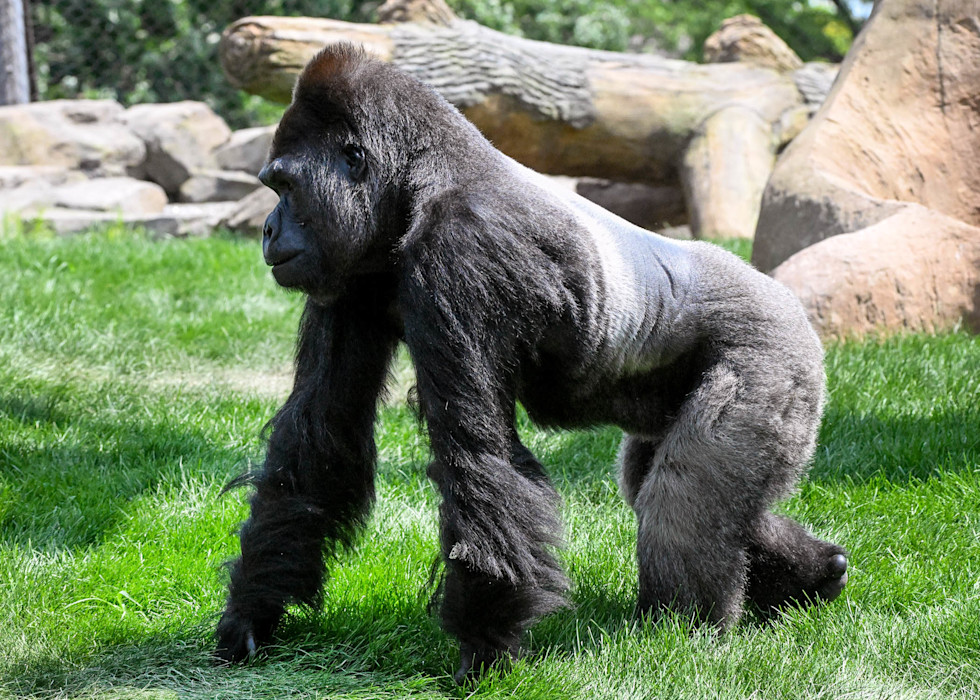
Social grooming is also a key activity in the social lives of primates, said Kimberly Skelton, director of Animal Care and Conservation, Primates. “Primates can often be seen picking through each other’s fur with their hands and removing dirt or debris. At times, they will use their teeth to pull out any stubborn particles,” she said. “You’ll see them taking turns to groom one another.”
“Grooming is a way for individuals to express trust, build alliances, reduce tension, and reinforce social hierarchies,” said Skelton. “It encourages group cohesion while reducing aggression within a group.” Social touch is also extremely important as it contributes to healthy emotional development in young primates, she said.
Cattle Brushes, Mist Showers, and Mud Wallows
Some animals need hands-on grooming assistance from our animal care specialists. “We do baths for one of our red river hogs because it has a dry skin issue,” said Carrie Jung, lead animal care specialist, Hoofed Mammals. Some species native to regions that are cooler or drier than the Midwest need extra attention. They include llamas, native to the cool Andes Mountains of South America. The Zoo’s llamas have a thick fleece coat that needs to be sheered during the summer so they won’t overheat.
Bactrian camels also receive help to shed their 20-to-30-pound winter coat, which comes off in large chunks, said Jung. That’s because the climate here is more humid than their natural habitat in the dry regions of Mongolia and China. The humidity causes their coat to become matted, she said, which can lead to fungal infections if animal care specialists don’t remove the chunks.
The Zoo’s animal care specialists give animals the tools and incentives to groom themselves, which contributes to their health and well-being. Most obvious are pools and tubs of water for species that bathe or groom in water, or jump into water to cool off, such as our polar bears and brown bears. A mud bath was built into the habitat of the red river hogs and rhinos are given showers in their indoor habitat. They enjoy rolling around in the muddy pools of water.
“Preening is among the repertoire of behaviors we want to promote,” said Hickman. Because getting wet initiates preening behavior in birds, Hickman’s team add devices that spray a misting rain in many bird habitats, he said. “We feed penguins in the water — it causes them to swim and then they preen their feathers for 10 to 20 minutes.”
Installing grooming devices in animal habitats also provide environmental enrichment for animals, which keeps them mentally and physically active. They can rub off excess hair or fur on a rock or a textured log. “During shedding season, we provide cattle brushes for bison to rub on as well as donated street sweeper brushes,” said Vinci. “They take advantage of that to help shed themselves.” Brushes are also hung up in the behind-the-scenes habitats of the snow leopard, Amur tiger, and wombats.
We encourage grooming in primates, said Skelton. “We offer a variety of materials like hay, wood wool, and leaves which can stimulate grooming activities as they pick out pieces of debris from their fur,” she said.
“Our care staff also provide scent enrichment that can encourage scent washing, or rubbing with pungent-smelling items such as onions. This is a communal and even therapeutic activity. Some scientists believe this can also be medicinal as plant rubs help primates get rid of or prevent parasites.”
Animal Pedicures
The nails, claws, and hooves of some animals need special attention and care. Some of our animals are trained to participate in this care. Many of our big cats are trained to voluntarily present their paws to animal care specialists to be examined. They hold still while their nails are trimmed. “If the nails get too long, they can grow into the pad of the foot,” said Pohl. Our vigilant staff prevent this from happening.
Preventative hoof maintenance is an essential part of the overall care of our ungulates, or hoofed animals. An overgrown hoof can cause long-term harm to an animal’s feet, legs, and entire body. A hoof trim is a painless procedure for the animals because their hooves are primarily composed of keratin — the same hard substance that human fingernails and toenails are made of.
An annual physical exam of an ungulate includes a hoof trim. But some animals — reticulated giraffes and African dwarf goats — need this service once a month. In 2023, members of our giraffe care team and one of our veterinarians attended a workshop with the Zoo Hoofstock Trim Program in Colorado and learned how to detect hoof problems, including hooves that need trimming, and use specialized tools to trim them.
After two months of positive-reinforcement training, each giraffe learned to voluntarily lift and present each hoof to animal care specialists to be trimmed. Ungulate care staff are in the process of training other ungulates.
Cleaner Organisms
In the marine world, there are fascinating examples of symbiotic, or mutually beneficial relationships, among species that would normally be enemies — predator and prey. “All fish have a mucous slime coat that keeps them clean and free of parasites in an ideal world,” said Mike Masellis, lead animal care specialist, Aquatics. However, some fish in the world’s oceans are plagued by parasites or other health conditions and have developed symbiotic relationships with cleaner organisms.
“In the Caribbean, neon gobies set up cleaning stations on coral heads,” said Masellis. Client fish visit cleaning stations and allow the gobies to eat parasites, dead or diseased tissue, algae, and excess mucous off of their bodies. This benefits the client fish and the gobies enjoy a meal, he said.
Cleaner organisms are usually not eaten by their clients, who seem to recognize them. For example, moray eels, which are carnivorous predators, open their mouths to allow cleaner shrimp to pick edible particles off of their teeth. You can look for cleaner organisms at The Living Coast. Besides the neon goby, they include the striped cleaner wrasse and the fire and white-booted cleaner shrimp. However, since our animals are regularly fed and examined for parasites, you probably won’t see the cleaners in action.