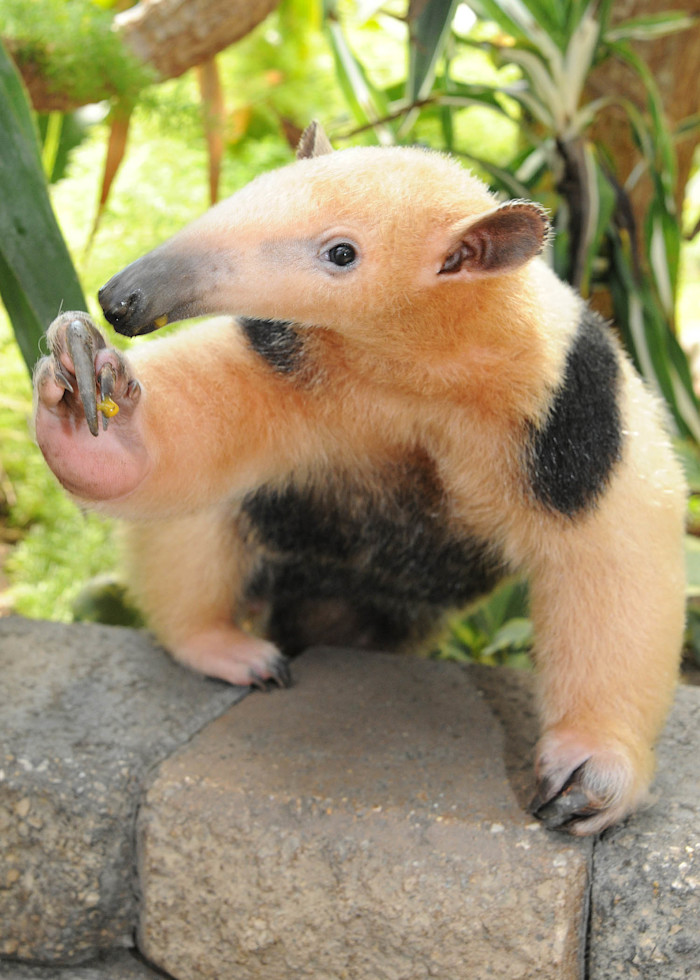
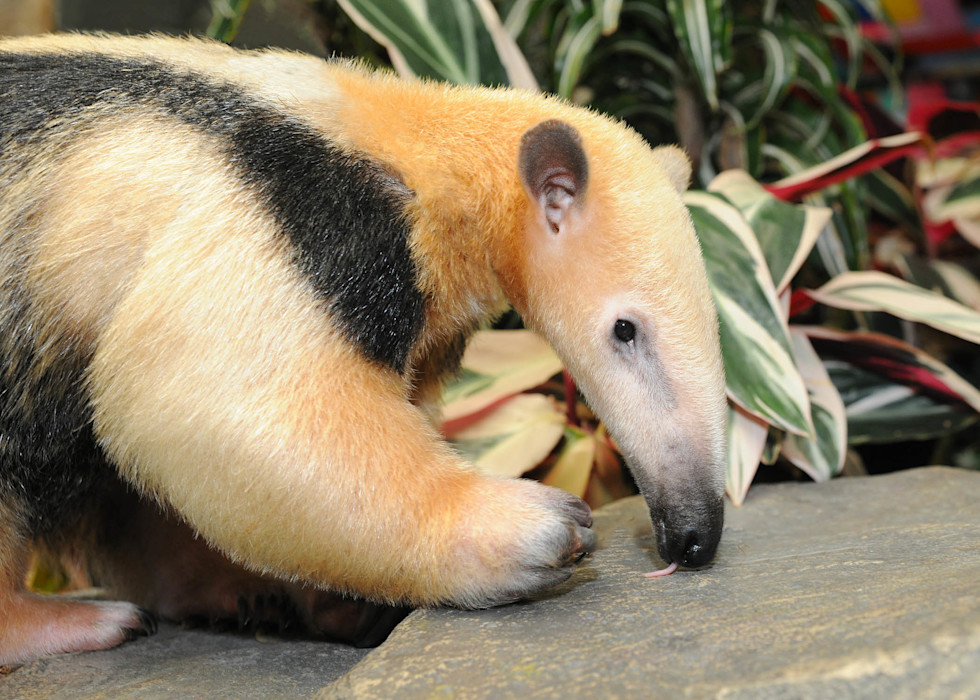
You may not have heard of the southern tamandua (Tamandua tetradactyla), but if you visit Hamill Family Play Zoo, they’re hard to miss! Also known as the lesser anteater, these animal ambassadors now have a new guest-facing habitat where you watch (and smell) the charismatic “stinkers of the forest” in action. Here are some things you might notice on your visit:
Tamanduas let off a strong scent.
Tamanduas release a strong, almost skunk-like odor from their glands to keep predators away. Hence the name, stinkers of the forest! They also have a strong sense of smell themselves.
Tamanduas may be small, but they are mighty climbers and fighters.
Tamanduas range from 21 to 35 inches, with a tail that adds another 16 to 23 inches. As an arboreal species native to much of South America, tamanduas have powerful forearms and claws used both for climbing and defense. They can use their hind feet and prehensile tail to cling to tree branches while fighting threats with their claws. In fact, their claws are so important to them, even babies are born with disproportionately large claws!
Since they are mostly solitary, they rely on many defense mechanisms.
Tamanduas aren’t great at walking.
Because tamanduas spend a lot of time in the trees, they aren’t as graceful on the ground. An extra-long claw on their third toe causes them to walk on the outside edges of their front feet. But while it’s tricky for them to walk, that claw is used both for defense and digging within trees for their favorite food.
Tamanduas eat with a long tongue and no teeth.
Tamanduas can eat up to 9,000 ants a day! It’s hard to imagine eating such a big meal without teeth, but thankfully, their 16-inch-long sticky tongue with barbs does the trick. After using their claws to dig open a hole, tamanduas use their tongue through a small mouth opening to grab arboreal ants or termites. Once the meal hits their stomach, special muscles within the organ grind up the food after swallowing.
Tamanduas also know how to avoid more dangerous ants, like leaf-eating or army ants. They also enjoy honey, bees, and fruit juice.
Tamanduas have protective fur and unique coloration.
Tamandua fur keeps ants away from their skin so that they can feed in peace. The underside of their tail, however, is hairless, making it better for clinging to branches.
Their fur coloration differs by region — in the more southeastern parts of their range throughout South America, they are more likely to have a darker black marking. This coloration is called “strongly vested.” In Brazil and Venezuela to the rest of the Andes, though, they are more “lightly vested,” with less of a distinct dark marking.
Tamanduas at Brookfield Zoo Chicago are full of personality.
There are three tamanduas that live at Brookfield Zoo Chicago as ambassador animals. Pedersen, the only male, is very energetic, even though he is a little bit older. He goes for runs on a wheel, stomps around in the mud, and gets very dirty while searching for ants. With his large front claws, he tears bark off trees.
The female tamanduas, Talulah and Kerry, are sweet and relaxed. Talulah is both the oldest and the smallest of the three. During summer walks around the park, she will find an ant hill and spend 20 minutes eating as many ants as she can.
Kerry, the youngest of the 3, arrived from Staton Island Zoo in 2025. She enjoys training sessions with our animal care specialists. Kerry is a bit of a picky eater, but her favorite food is avocado! She and Talulah have similar light-black vests that don’t connect at the bottom, while Pedersen has a very dark black vest that makes a distinct “V” shape. See if you can spot the difference when you visit Hamill Family Play Zoo!