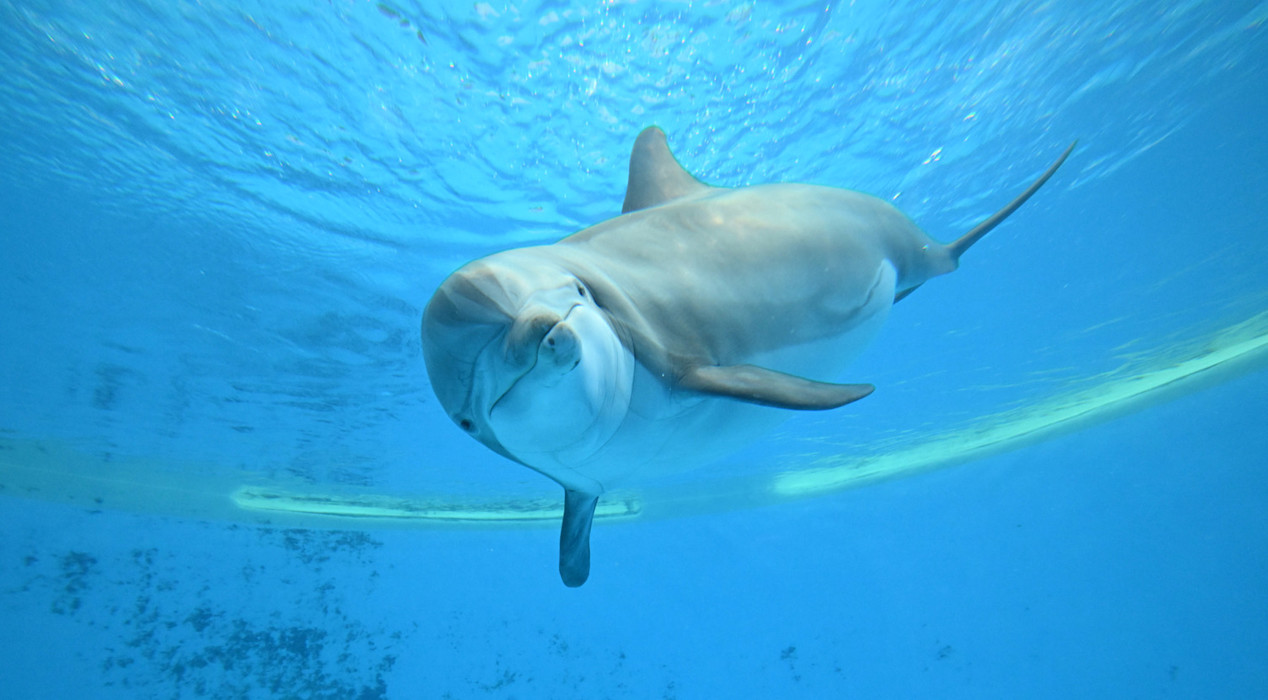
We are devastated to share the sudden loss of bottlenose dolphin Allison’s calf on September 16, 2026. In the following, Brookfield Zoo Chicago’s animal care and veterinary teams shared the earliest milestones of the dolphin calf’s life — from the first signs of labor and the first breath, to his last.
For nearly a year, Brookfield Zoo Chicago’s animal care and veterinary teams have been preparing for this moment — all prompted by the ripple of phone calls through a phone tree for responding staff.
After less than two hours of labor on September 9, 2026, bottlenose dolphin Allison gave birth to a male calf at Dolphin Bay, marking the beginning of an extraordinary journey for both the 20-year-old mother and her calf.
Just moments after birth, the calf instinctively swam toward the surface and took its first breath. While dolphin calves are born after a 12-month gestation and arrive in the world fully developed, they remain highly dependent on their mothers during their first year of life.
While the calf’s arrival is an important milestone, it is only one chapter in a much longer story. Zoo staff are closely monitoring both mother and calf as they navigate critical developmental milestones together.
“Every dolphin calf teaches us something new,” said Dr. Mike Adkesson, Brookfield Zoo Chicago President & CEO. “The observations made during these first hours and days help deepen our understanding of dolphin development and maternal care. Our focus is on giving both Allison and her calf the support they need while learning from every milestone along the way.”
Below is a look at some of the earliest milestones observed by our animal care and veterinary teams. This page will continue to be updated as Allison and her calf’s story unfolds.
Birth Timeline: Wednesday, September 9, 2026
8:30 a.m. – Daily morning temperature check
Allison began her day like many others — with a voluntary temperature check alongside the animal care team she knows well. Her basal temperature slowly began to decrease but not significant enough to indicate labor was imminent.
This is just one example of the care she voluntarily participated in throughout her pregnancy, with ultrasounds, blood collection, and specialized training sessions helping caregivers to closely monitor both her health and the calf’s development.
2:30 p.m. – Preparations begin
During Allison’s afternoon temperature check, a significant drop in her basal body temperature was recorded — nearly two degrees below her recent average. While no single indicator can predict when labor will begin, a temperature decrease is one of the most reliable signs that birth may be imminent. Animal care and veterinary teams activated 24/7 monitoring protocols and prepared for what could be an exciting evening.
4 p.m. – Continued appetite
Throughout much of the day, Allison’s behavior remained relatively consistent. A few subtle abdominal crunches were observed but no major changes. Importantly, she continued eating normally. A declining appetite can sometimes signal that labor is approaching, making Allison’s interest in food one of several factors caregivers were closely monitoring.
8 p.m. – Labor nears
Allison refused fish for the first time then began showing more obvious signs of labor, including gentle bending and flexing — movements similar to contractions. Despite increased activity, animal care team members noted that she remained calm leading up to labor.
8:44 p.m. – Flukes out!
The calf’s flukes, or tail fins, became visible and indicated delivery was underway. At birth, a calf’s flukes are soft and folded from their position in the womb, with this first observation allowing the flukes to unfold and stiffen in preparation for the calf’s first swim to the surface.
9:39 p.m. – Calf’s first breath
After less than an hour of labor, the calf swam to the surface for its first breath. The calf is estimated to weight about 33 to 37 pounds and measure 115 to 120 centimeters long.
“The first hours after birth are an important learning period for both mother and calf,” said Dr. Rita Stacey-Vondra, Brookfield Zoo Chicago Senior Vice President of Programs and Impact. “For an inexperienced mother like Allison, many of these behaviors develop in real time. We were watching closely as Allison and her calf began learning from one another, with the calf relying on her guidance and support while she adjusted to the demands of caring for a newborn.”
First-Day Milestones: Thursday, September 10, 2026
12:30 a.m. – Round-the-clock monitoring
As the excitement surrounding the birth settled, many team members headed home and a smaller overnight team remained focused on continuous monitoring. The calf began to more easily navigate the habitat in a position known as slipstreaming, using its mother’s movement through the water to help conserve energy while building strength and coordination. Every breath, nursing attempt, and interaction between Allison and her calf would be carefully documented, creating a detailed record of the calf’s earliest hours.
1:30 a.m. – Placenta passed
Allison successfully passed the placenta, another important milestone for both mother and calf. Overnight staff collected it for veterinary examination, as the placenta offers valuable first insights into the calf’s health and helps confirm the calf’s sire, or father.
2:34 a.m. – First feeding on the fly
Allison resumed eating fish while swimming alongside the calf, a behavior she trained for known as “feeding on the fly.” Maintaining a healthy appetite is an encouraging sign following birth and helps provide the energy needed to support milk production and round-the-clock maternal care.
3:50 a.m. – First nursing observed
About six hours after first breath, animal care specialists documented the calf successfully nursing. Unlike many mammals, dolphin calves nurse while swimming alongside their mothers. Learning to coordinate swimming, breathing, and nursing simultaneously is one of the earliest developmental challenges a calf faces.
8 a.m. – Habitat enters quiet period
As the day begins for staff across the Zoo, Dolphin Bay remains in quiet operating mode to provide an environment conducive to bonding, nursing, and early calf development during these critical first days. The habitat is temporarily closed to guests, and Dolphin Bay presentations are suspended while animal care specialists focus on actively monitoring Allison, her calf, and the dolphin group.
5 p.m. – Overnight monitoring continues
As the Zoo closed for the evening, monitoring efforts continued uninterrupted for Allison and her calf. These observations are compared with decades of dolphin development data, helping Zoo staff better understand how the calf is progressing relative to milestones documented in previous successful births.
Beyond the First 24 Hours
While the calf is showing encouraging signs of strength and has begun nursing, the first few days and weeks remain critical for both mother and calf. Animal care and veterinary teams will continue close monitoring as new milestones emerge.
The weeks ahead include physical changes in addition to the many behavioral milestones to come. The calf’s dorsal fin and tail flukes will continue to straighten as they stiffen. Calves are also typically darker gray than adults and often display vertical light-colored lines on their sides, a result of fetal folding that gradually disappears within the first six months.
For now, the focus remains on supporting Allison and her calf as they navigate life’s earliest milestones, one breath, one nursing session, and one swim at a time.
The Journey Continues
Saturday, September 12, 2026 – On the move
The calf successfully navigated the channel between habitats alongside Allison for the first time, an important milestone that requires coordination and confidence. Animal care specialists also continued documenting regular nursing sessions.
Monday, September 14, 2026 – It's a boy!
Allison’s calf is confirmed to be male. He continues to show signs of healthy development, with consistent nursing now resulting in visible weight gain and a fuller body condition.
Tuesday, September 15, 2026 – Keeping a close eye on nutrition
Allison is demonstrating some positive maternal behaviors, but her maternal care is not yet consistent. At times, she allows the calf to swim farther away from her than is ideal.
Research on wild bottlenose dolphins emphasizes that this can be an especially vulnerable period, with calves born to first-time and inexperienced mothers facing greater challenges during their first year. These are realities our team understood and prepared for throughout Allison’s pregnancy, and they continue to guide the careful, measured way we are caring for and evaluating the pair.
Wednesday, September 16, 2026 – An unexpected loss
After the calf continued to show strength during overnight monitoring, the calf rapidly declined early this morning. Our teams responded immediately, but unfortunately he did not survive.
“Reproduction and caring for young is a natural part of any animal’s life and an important part of their well-being. While Allison demonstrated some of the maternal behaviors required to help her calf thrive, ultimately, they were not consistent or enough to sustain the calf’s needs,” said Dr. Rita Stacey Vondra, Senior Vice President of Programs and Impact at Brookfield Zoo Chicago. “Our entire team is devastated by this loss but remains focused on supporting Allison’s health and well-being in the days ahead.”
While initial assessments showed some positive maternal behaviors, Allison struggled with other maternal care that would help the calf reach critical developmental milestones in areas where human intervention was not possible. A full necropsy, or animal autopsy, is underway and will help us learn more.