A Q&A with Director of Primate Care and Conservation Kim Skelton
Your heart may have melted recently at the sight of a small, abandoned monkey dragging around a plush orangutan. Internet sensation Punch the macaque might make you feel like curling up with your favorite childhood stuffed animal — and we get it. After all, we're obsessed with primates, too.
But while Punch and his plushie cause us to feel warm, cozy, and empathetic, there's more to his story than meets the eye. To integrate with the troop, he has to learn to navigate complex primate social dynamics. Sometimes, these dynamics may take us by surprise. Even behaviors that look negative to us can be important to an animal's welfare.
Kim Skelton, Director of Primate Care and Conservation at Brookfield Zoo Chicago, specializes in the management of complex primate social groups. She’s joining us to discuss Punch and the social life of primates.
Who is Punch and why is he internet famous?
Punch is a juvenile macaque under the care of a Japanese zoo. From reports, Punch's mother didn’t engage with or maintain proximity to the infant. As a result, Punch became attached to human caretakers and a stuffed orangutan provided by the animal care staff.
Much of his fame is coming from the attribution of human emotions to Punch’s situation. This is also known as anthropomorphism. While his story gives us a great sense of empathy for him, it is not uncommon for primates to face social challenges when integrating into a troop. The way a human would feel in his situation is very different from his own relational experience.
Why would a primate’s mother abandon its baby?
Primate mothers may reject their infants for several biological or behavioral reasons, such as inexperience being a mother, infant illness or developmental abnormalities, high social stress within a troop, or disruptions during the critical bonding period right after birth. These factors can interfere with the normal establishment of maternal care.
While people may interpret the situation in emotional terms, the primary concern for the infant is not sadness or loneliness. Instead, the risks are clinical: the loss of warmth, nursing, protection, and social integration that maternal care normally provides.
How do primates interact with each other?
Primate social structures are very complex, and many involve an established social hierarchy, particularly in macaques. As a primate infant develops, it must learn how this hierarchy functions. Behaviors that may appear to humans as bullying or scolding—such as brief chases, physical displacement, vocal reprimands, or mild swats from other troop members—are typical forms of social correction. They help the infant learn dominance relationships and appropriate boundaries within the hierarchy.
These social correction behaviors are what we refer to as species-typical behaviors. They often indicate that a primate group is functioning normally, even when the interactions appear alarming from a human perspective. For Punch, the fact that he has begun interacting with other troop members without sustaining significant injury suggests that integration into the group is progressing in a typical manner.
Do primates get stressed from lack of social interaction?
Most primate species are highly social, and a lack of social interaction can produce measurable stress responses.
In social primates—such as macaques, lemurs, gorillas, and many monkeys—regular interaction is a core component of normal behavioral and physiological regulation. When individuals are socially isolated or deprived of typical group interactions, researchers have documented increases in stress-related hormones (particularly cortisol), along with changes in behavior.
Social interaction serves several important functions for primates, including grooming (which reduces physiological stress), learning social rules, forming alliances, and maintaining group cohesion.
Depending on an individual primate's context, some primates may temporarily tolerate reduced interaction. However, prolonged social deprivation is generally considered a significant welfare concern for social primate species.
More recently, Punch seems to have been accepted by other macaques in this troop. How does this work?
More recently, videos and posts on social media have shown Punch spending time with other macaques in his troop, with one monkey seemingly helping him with grooming. This suggests that he is beginning to integrate into the group’s normal social structure. When another macaque begins grooming or spending time with an infant like Punch, it often indicates that the troop is gradually incorporating him into the group’s social network, which is an important step toward normal social development.
How do animal care experts take care of monkeys that need help like Punch?
Social interaction is one of the most important aspects of animal welfare. To help a primate like Punch, animal care experts focus first on restoring the conditions that allow it to develop and live within a normal social environment. When an infant or individual needs additional support, animal care teams step in with a combination of veterinary care, behavioral management, and carefully planned social introductions.
At organizations like Brookfield Zoo Chicago, the primary goal is always to maintain or re-establish stable social structures. Primate species such as macaques and spider monkeys rely on group living to learn communication, hierarchy, grooming behaviors, and social boundaries. That’s why animal care specialists work closely with veterinarians and nutrition teams to monitor health, ensure proper diet, and observe social interactions while planning gradual steps to return the individual to an appropriate social setting.
Sometimes short-term supportive tools help while that process is underway. For example, providing a soft object or stuffed animal is a recognized enrichment strategy for orphaned or rejected primates. Infants naturally cling to their mothers for warmth and security. A surrogate object can provide a temporary tactile substitute that reduces stress while we monitor the animal and evaluate social options. This is not intended as a long-term replacement for social contact—its purpose is to stabilize the infant until appropriate social integration can occur.
What are the primate social dynamics like at Brookfield Zoo Chicago?
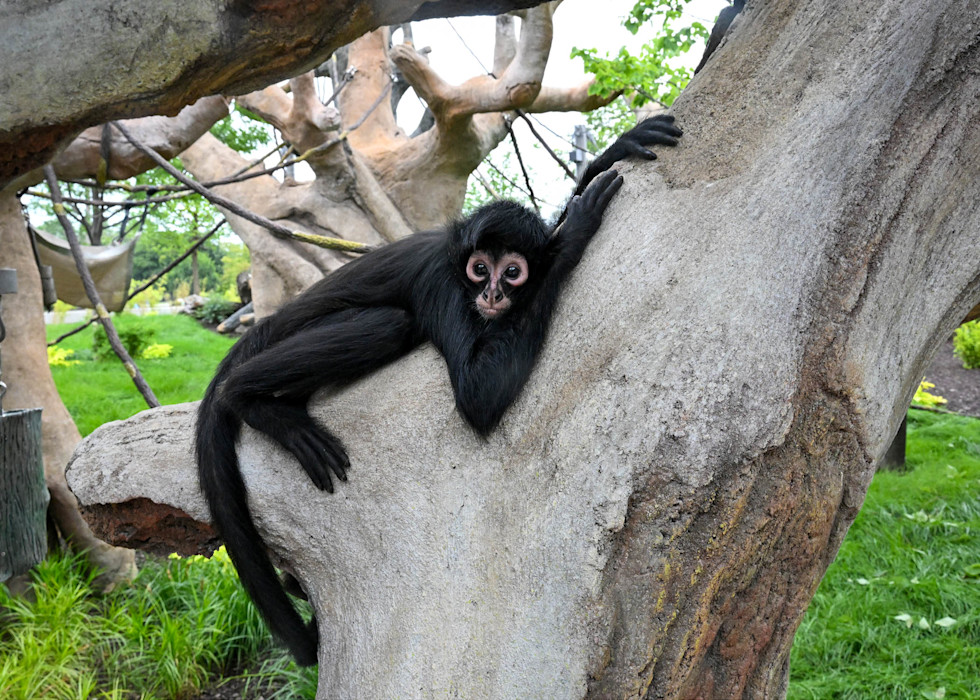
Our Zoo is home to nine species of primates, each with their own set of social dynamics. The spider monkeys at the Zoo are a good example of primates with complicated social dynamics. And recently, they also needed some extra help from our animal care specialists. In 2025, we welcomed five spider monkeys rescued from trafficking to the Zoo. Gradually, we helped them recover and then integrate with a group of older spider monkeys already living at the Zoo. Animal care teams introduced individuals through a series of structured steps:
Protected contact across a mesh barrier
Visual and auditory exposure
Gradual increases in shared space
Continual behavioral monitoring
Staff watched closely for bonding behaviors such as proximity, grooming attempts, and relaxed body posture. They also made sure that any normal dominance behaviors did not escalate to injury. Through this deliberate process, the rescued spider monkeys were successfully integrated into a functioning social group. Now, you can see them swinging together through the branches or sitting side by side at the viewing window in Bramsen Tropical Forests.
Ultimately, the focus of modern primate care is always the same: support the animal’s health and development while returning it to a stable, species-appropriate social environment as safely and quickly as possible. Temporary tools and close human oversight can help during transitional periods—but the long-term goal is for primates to live and learn within their own social groups, where they can express the full range of natural behaviors that define their species.
What can someone do if they want to help an animal like Punch?
Learn about the species. Understanding macaque biology, social behavior, and conservation status helps people interpret situations accurately and support science-based care.
Share accurate information. Helping others understand primate welfare and conservation issues can reduce misinformation and increase support for protecting these species.
Support accredited zoos and conservation organizations. Facilities accredited by groups like the Association of Zoos and Aquariums (AZA) contribute to animal welfare, research, and global conservation programs.
Help combat the illegal pet trade. Remind others that monkeys and other primates are wild animals with complex social and environmental needs that cannot be met in private homes. Avoid sharing or promoting content that encourages primates as pets, such as monkeys in human settings.
Support conservation efforts financially or through volunteering. Donations or participation in conservation programs help protect primates and their habitats.
Advocate for habitat protection. Many primate species face threats from deforestation and land conversion, so supporting sustainable practices and conservation policies helps protect wild populations.
Visit and engage with educational habitats at accredited zoos, like Bramsen Tropical Forests. These experiences can help you understand primate behavior, social structures, and conservation challenges.